After the end of World War II, the Soviet Union took control of Eastern Europe and installed Communist governments in many countries. In the decades that followed the people of these countries tried to escape Communist rule but were fought against by the Soviet government.
In the ten years that followed the war, the Soviets virtually controlled all life in Hungary. They installed a secret police and made economic decisions. The country’s newspapers were censored and the Russian language was introduced to Hungarian schools. Religious freedom was banned and authorities put Cardinal Mindszenty into prison.
In October 1956, Imre Nagy became prime minister in Hungary . He was moderate and also wanted to free Hungary from Russian control. Students and other intellectuals went to the streets to demand more freedom from the government . A few days after taking power, Soviet leader Nikita Khrushchev agreed to remove Soviet soldiers from Budapest . In the following days, Nagy introduced a series of reforms, including the freedom of the press. The leader of the Roman Catholic Church, Cardinal Mindszenty, one of the Soviet Union’s harshest critics, was released from prison. People protested freely on the streets of the Hungarian capital and even took down a statue of Stalin.
After announcing that Hungary was going to leave the Warsaw Pact, a Soviet-led military organization to protect Communist Europe, Russian tanks entered Budapest on November 4th, 1956. Thousands of citizens fought against the Soviet soldiers with all the weapons they had. Many people were killed in the uprising and thousands of Hungarians were arrested. Over 200 000 packed their belongings and fled across the border to Austria . Prime Minister Nagy was arrested, put to trial and executed two years later.
At the end of one of the worst moments of the Cold War, the Soviet Union had regained control of Hungary and installed Janos Kadar as the new Communist leader. In the following decades other countries also tried to rise against Soviet power. In 1968 Soviet tanks crushed an uprising in Czechoslovakia and in 1981 the Soviets moved into Poland.
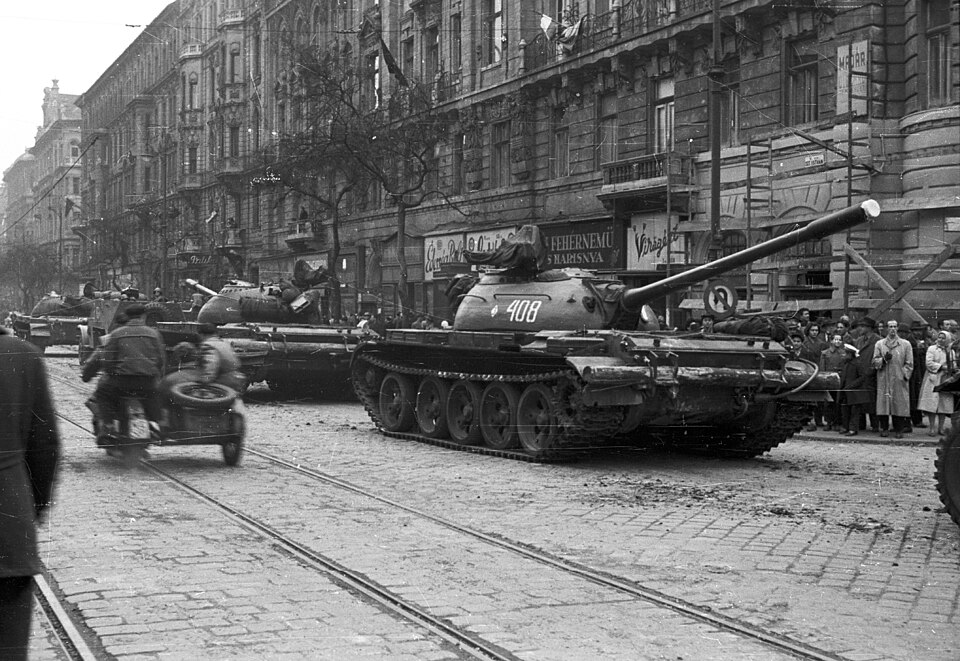
Soviet tanks in the streets of Budapest in 1956
Image: FOTO:FORTEPAN / Nagy Gyula, CC BY-SA 3.0,
via Wikimedia Commons
_utca_fel%C5%91l_a_Honv%C3%A9d_utca_fel%C3%A9_n%C3%A9zve._A_szovjet_csapatok_ideiglenes_kivonul%C3%A1sa_1956._okt%C3%B3ber_31-%C3%A9n._Fortepan_24787.jpg)
Words
- agree = to say yes
- arrest = to take someone to a police station because they may have done something wrong
- authorities = group of people or organization with certain powers
- ban = forbid, not allow
- belongings = the things that you own
- capital = most important city of a country; where the government is
- censor = to check newspapers, television and other media to see if there is something there that you don’t want people to know about
- citizen = person who lives in a country and has rights there
- crush = to stop people from fighting against you
- decade = ten years
- demand = you want someone to do something
- economic = about the economy and business
- escape = get away from
- execute = to kill officially
- flee – fled = to escape to a safer place
- government = the people who rule a country
- harsh = tough, strict
- including = also
- install = here: to put a group of people into important positions
- intellectual = person who is well-educated and has serious ideas
- moderate = here: if you don’t have extreme opinions
- prison = place where you are kept if you have done something against the law
- protect = defend
- reform = changes in a country in order to make things better
- regain = to get something back
- release = free
- remove = here: move away
- rise = here: to try to defeat a government
- Soviet Union = largest Communist country in the word, which existed between 1917 and 1991
- tank = heavy object that moves on metal belts and has a large gun on its top
- trial = an event in which a jury and a judge decides if you are guilty of having broken the law
- uprising = rebellion; when people fight or protest against their own government
- virtually = nearly, practically
- weapon = something that you use to fight against someone, like a gun, knife or a bomb