The Thames Barrier is a system that prevents London from being flooded by North Sea storms. It lies in the eastern part of London, about 15 km from the Houses of Parliament. The Thames Barrier was built in the 1970s and has been in operation since 1982. It cost over £500 million and is operated by the Environment Agency.
In normal weather, tides cause the Thames River to rise and fall by about 5 metres twice a day. Heavy storms in the North Sea, however, combined with rising tides can push too much water up the Thames and flood central parts of the city. When this happens, the gates of the London Barrier are raised to keep water away from the city.
In the course of history, London has witnessed many cases of extreme flooding. The worst event took place in 1953, when 300 people died during a heavy storm that spread across the North Sea and flooded the city. After this disaster, city planners decided that something had to be done to protect the city.
Today, 10 rotating steel gates span the 520-metre wide Thames River. Under normal conditions, the five storey high gates are down and ships can pass through. When danger approaches, the 3000-ton gates can be raised within minutes to keep excess water out of the city area. Since the opening of the barrier in 1982, the gates have been closed over 170 times. Recently, however, the gates have been closed very often due to rising sea levels.
The Thames Barrier is one of the most important flood defence systems in the world. It protects over a million people who live and work in Central London. It also protects historic buildings, infrastructure and the London Underground.
The barrier was originally designed to protect London up to the year 2030. Climate experts say that sea levels are rising slower than predicted so that the barrier will be operational through to 2070. Still, changes must be made to the barrier so that it can cope with extreme weather situations in the future.
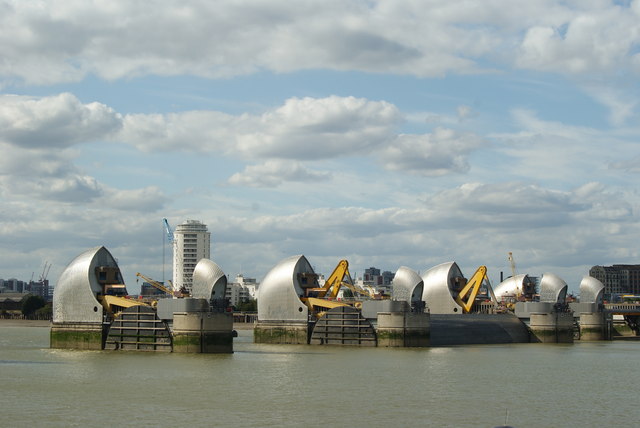
Thames Barrier in an open position
Image: Peter Trimming / Thames Barrier
Words
- approach = come near
- cause = to make something happen
- combined = together with
- cope = handle , manage
- disaster = sudden event or accident that can destroy things and kill or hurt many people
- due to = because of
- Environment Agency = British government organization that makes sure rivers and water supplies are clean and that factories and industries do not harm the world around us
- excess = extra, more than normal
- flood = to cover an area with water
- gate = large wall
- however = but
- in operation = working
- infrastructure = basic systems that are needed for a city to work, like roads, hospitals, schools etc..
- operational = active, in use
- originally = at first
- predict = to say something will happen in the future
- prevent = stop something from happening
- raise = put up
- recently = here: in the last few years
- rotate = move around in a circle
- sea level = average height of the sea, used to measure other heights
- span = reach over
- spread = move
- storey = level of a building
- tide = the regular rising and falling of the sea
- witness = observe, experience